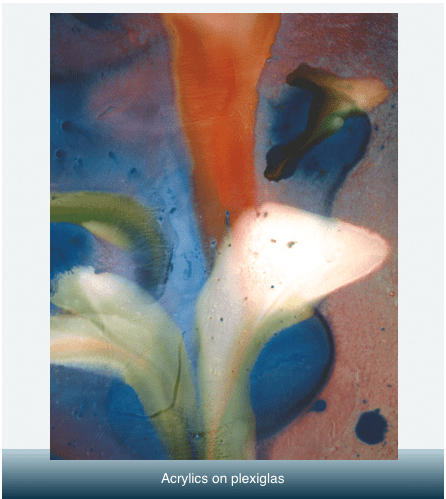
Pouring paints upon a surface, by the late 1980s when this image was created, was no longer accepted as a creative act. It was considered copy-catting. Old Hat. Outmoded by nearly a half century. And yet . . . this image is absolutely different and original from any ever poured on canvas.
Moreover, the image presented here delightfully defies four other dogmas settled upon the act of painting by painters and their art critics of the 1950s and 60s. Strident proclamations and manifestos, verbal and written, were made that a painted image should eliminate all spatial references in order to be fanatically in tune with its 2-D surface; a second equally rubbish commandment was that forms should not evoke reality; thirdly, that the content of art could concern itself only with its own abstract formal elements—colour, texture, shape, composition—and lastly, that all narrative aspects of image must be avoided at all costs.
Artists quickly painted themselves into monastic (or ivy league) corners with their stripes, chevrons, targets, and numinous mists. A few suicided out of the muddle, or complicated it even more with heavy alcohol consumption allied to a penchant for reckless driving. A few, like yours truly, shrugged off the demands of this newly ascended / assembled / self-appointed painting academy-in-the-sky: We would set our own rules.
Having gone off the artistic grid myself by choosing, in 1972, to live a creative life in a very small town in northern Newfoundland, I felt no obligation to blindly follow all the modern canons set out in my university’s Art History Major brain washings, 1967-1972.
Attempting to pour liquid colours upon resistant, slick plexi instead of onto absorbant canvas injects a totally different interaction between the colours, and how they will settle out as they dry. Add in the complication of working in reverse and there is a huge learning curve of acceptance of accident; of guiding rather than controlling the process; of becoming extraordinarily alert to the possibilities of the ground and the paints; even of which colours are not chemically compatible (and, if that were the case, how might that be creatively exploited to best advantage). It would sometimes take two or three days before the pools of paint dried enough to turn over the plexi to find the exact nature of what had presented itself on my own miniature self-defined altar.
In this instance I had no doubt that a completely original, lovely, lyrical piece of art had come into existence out of my humility before, and my collaboration with, the most contemporary of materials.
 fillière
I really like this one too!
LikeLike
Thanks here too Sherrie.
LikeLike