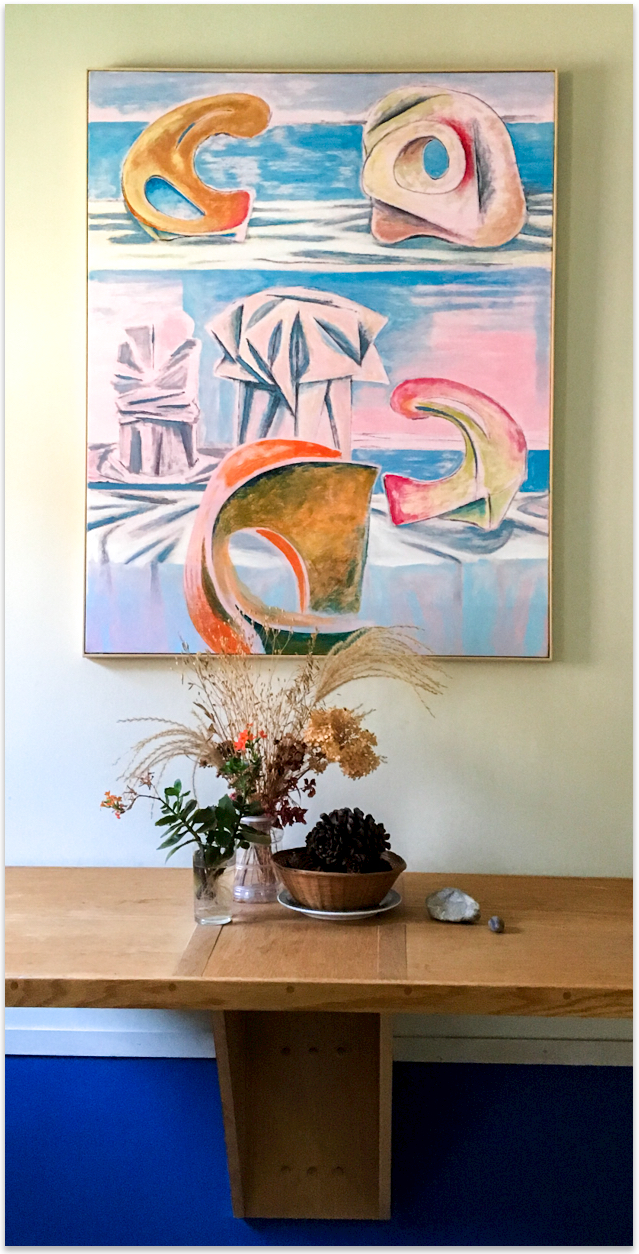
I’m guilty as charged of painting, frame, still life, table construction, room colour, photo. This is the east wall of my kitchen.
I’m guilty as charged of painting, frame, still life, table construction, room colour, photo. This is the east wall of my kitchen.
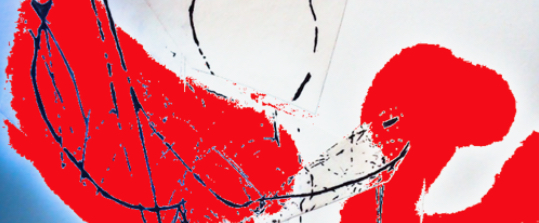
The Kingdom Is Divided Inch by Bloody Inch
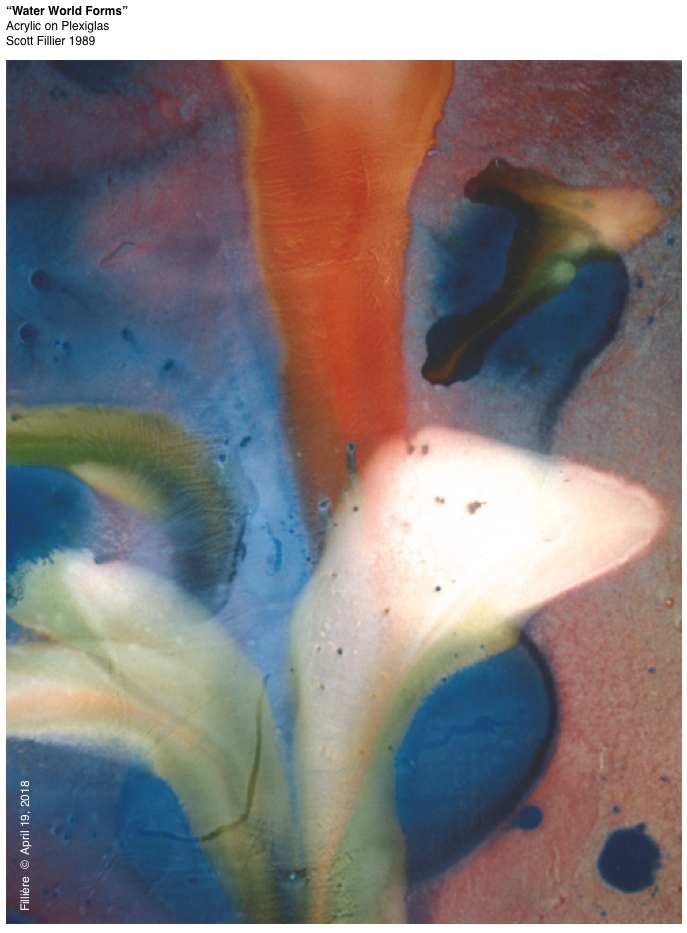
Three separate surfaces are used to compose this intricate abstraction. A Plexiglass square used on both its front and back sides leaves enough open areas for a backing board to create behind them a deep atmospheric space. In most instances abstractions deliberately avoid creating spatial depth, here deep space is celebrated as the natural necessary component it is.
Our front surface has the painted bright yellow triangle—lower left quadrant, while two smaller triangles, with the darker values of yellow, use the upper right quadrant. The dominant blue and red triangles, and the yellow and black half-circles, just above centre, are painted on the inner side, while a backing board spray-painted in muted greys, blues, and pale corals also carries the pasted down orange triangle and orange half-circle visible through the translucencies of the Queen and King triangles.
Qualities of paint and pigments range from absolutely opaque to the most delicate translucencies both in sprays and fluids. Plexiglass brings an incredible luminosity/numinosity to colour not available when painted on canvas or board. Geometric edges ride/soar/float against/over/under free-reign, free-flow forms. And the other complex dialogue about abstract spatial perceptions, and its advancing, recessional colours/tones, and between positive/negative forms is royally maxed out.
While these dynamic elements were being brought into a worthy balance my mind couldn’t resist romanticizing them as a levitating Red Queen and her foot-loose Blue King parting company and beginning to divide their quantum world spoils.

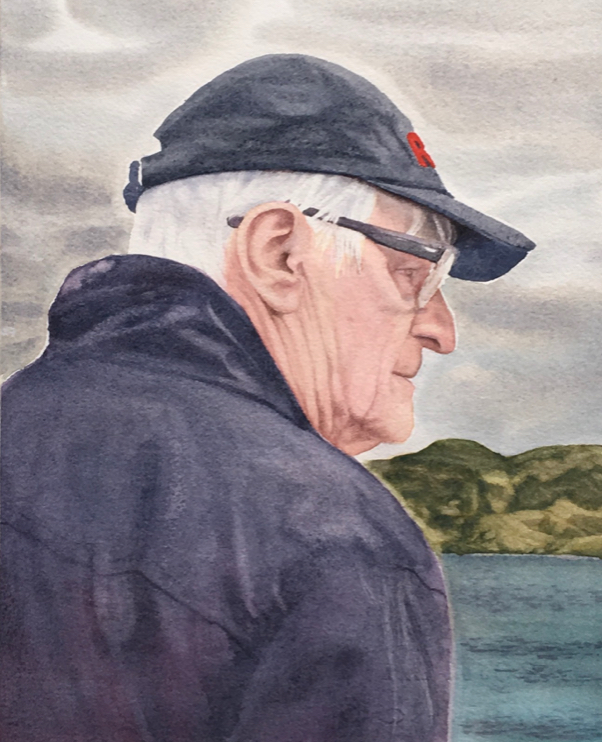
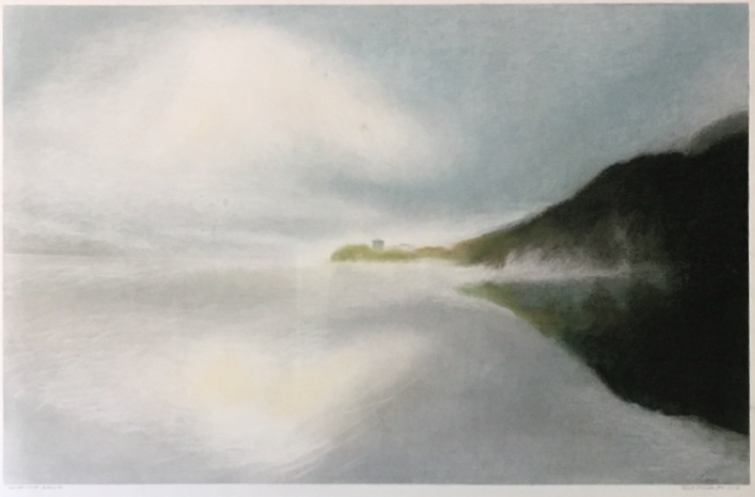
The watercolour is recent, June 2017.
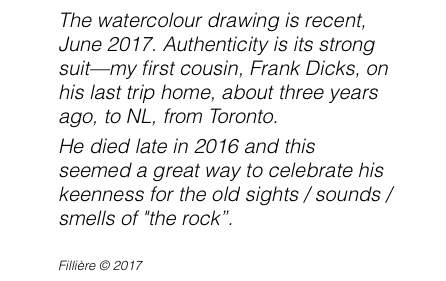

cold unbraid, bold unsplice, untie, unmoor coarse hemp of hold
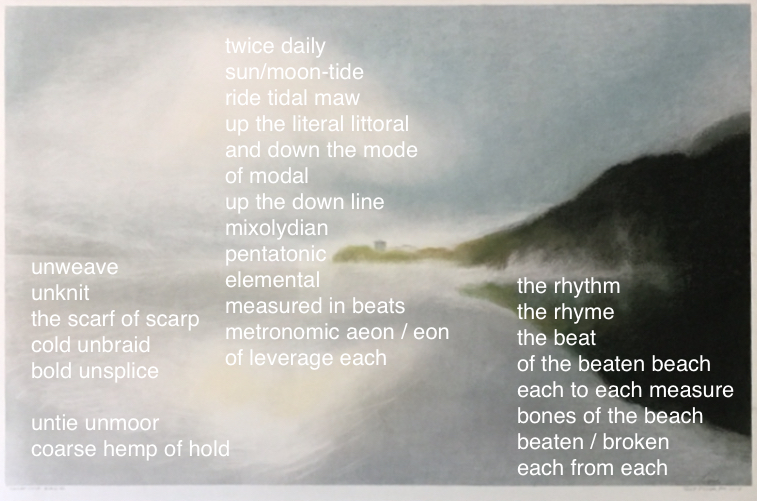
(In celebration of a new poem and pastel drawing, both from February 2017: Fillière). The pastel, without imposed poem, as below, has gone to live permanently with a cousin.
As soon
as I decide to blog
but as yet without
a chosen flog
the word “spark”
unplanned, unsought,
and as yet unfiltered,
parks itself point blank,
behind/in front of
the dark third eye;
the outer eye premature, stressed,
worried as a hemp-rough bell-rope
fingered, palmed, dangled, waiting,
waiting taut to be pulled sore
at the front of the cue,
at the front for the cure:
where the lure of live art
queues up like a ritual
Guy Fawkes Five
or a banner spangled Four.
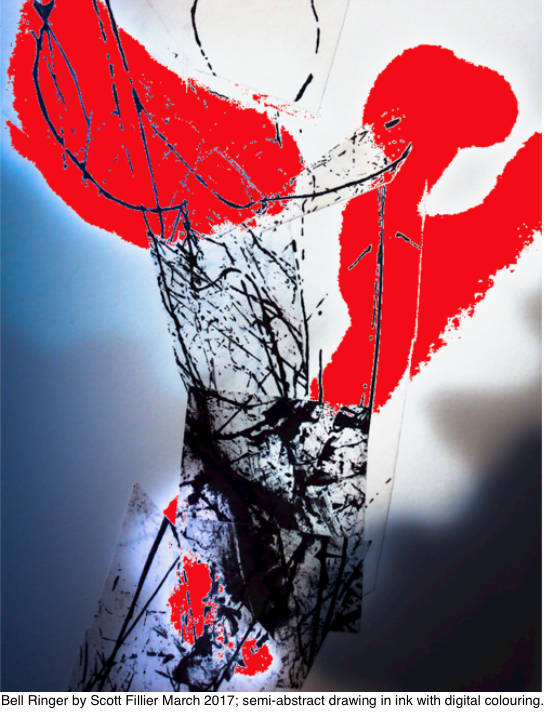
Like any old flash
all steeple tense,
all tower taut,
all seriously trigger-happy,
the bell-ringer’s incendiary fingers
ring out, tell out,
draw,
paint out
the negative charge,
the positive hots,
the hot spots and the cold spots
of yesterday’s within.
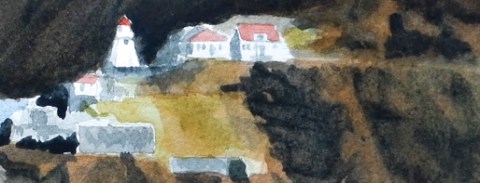
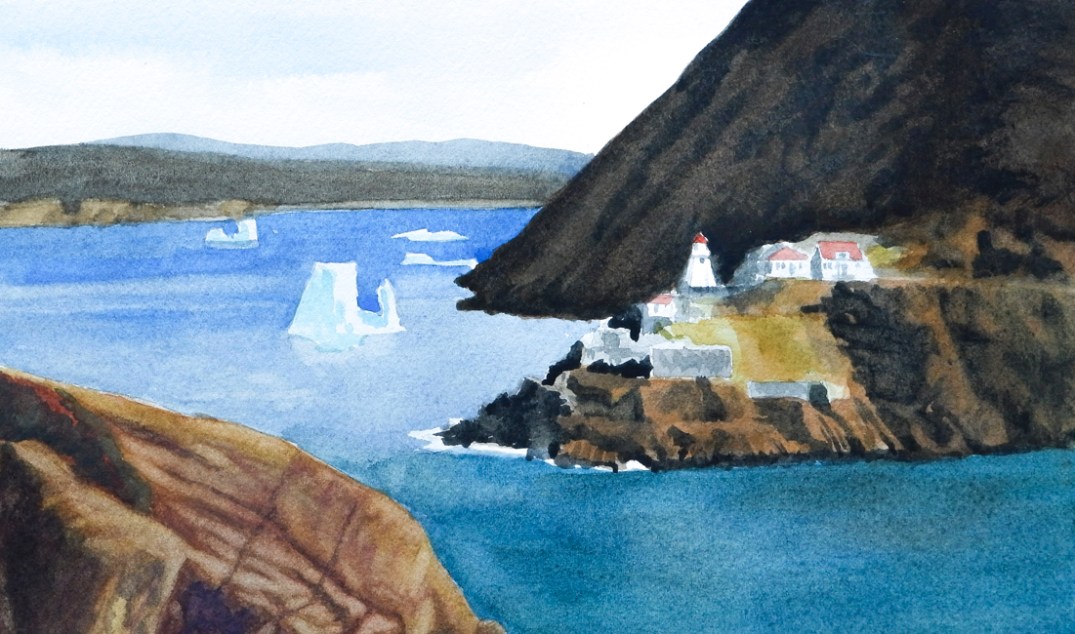
Transitory light of a setting sun emblazons the Fort Amherst south-side headland of St. John’s, NL in late April 2015. The viewpoint, from the Signal Hill side of The Narrows, is evanescent and spectacular where a climber, high, high, high amongst the rocks is breathless with vertigo not only from the steep climb up from The Battery, but from the stunning beauty of the distant view of lighthouse, houses, and support buildings in their dazzling display of white structures with red roofs, set against steep, stark shadows. Below them there is a large, steeply pitched area of withered grass with just a hint of seasonal change to green. Below that, several grey World War 2 concrete defence bunkers, with their crude early forms of architecture brut perched precariously, scrunched down, pretending to be equals of ancient, eternal crag, scarp, and cliff. At the final level down is the patient ocean with its longing to subdue the vain concrete forms.
A little offshore some pack ice and bergs imperceptibly drift into intertidal oblivion. The climber, clinging and resting amid some shrubbery in a rock crevice, steadies herself with one hand, and with the other raises her phone to capture the ephemeral scene. Breath held and then there is one barely audible fleeting click to record it, and some other clicks to send a copy on to me and others.
This week, two years later, I’ve used cousin Brenda’s photo to interpret the scene in what is considered to be the most useful medium to capture transient and fleeting effects: watercolour. Perhaps I can tool the temporary into something that might endure, like the bunkers, for at least some generations beyond my immediate goal.
 fillière