To Dream … Dream REset

Post 3

So then . . . BRAIN . . . what’s the deal?

What’s with you?

Why the infinitely repeated dream?

Why the insult and humiliation, night after night . . . the recurring reminders of lack of control?  Why, brain, why repeatedly wake me up, panicked, overheated, out of breath?

Don’t you think I know how little control I really have . . . ??!!!

I get it!  

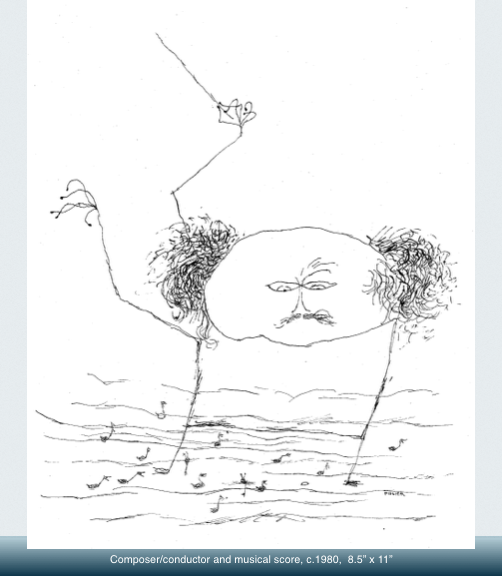
I know.  I want too much control—every note in perfect alignment, in perfect pitch, flawless melodies and harmonies, all in perfect Bachese / Mozartese / Brahmsese.  I totally get the grey-matter metaphor.

I also get that if it quacks like a duck it can in fact be a Lyrebird.

Maybe that’s why our hearts still yearn for 5-Star acoustic concert halls, the world’s best orchestral players—each a worthy soloist, playing only works of genius, conducted by the most perceptive and enlightened musical mind in generations.  For half an hour we can suspend the imperfect world we know and surrender to the fantasy of perfection.

You see how it all  works?  There, underneath all the nice words and phrases of that last paragraph, the same old irony, suspicion, and sarcasm;  there’s the Lyrebird delivering his chain-saw (or his cute little duckie) imitation:  the real world is kicking right back in, in vengeance;  prepping you for yet another repeat of . . . nothing less than . . . your own powerful impotence.

Might I enlighten with a working response to this taunting unconscious?

Time to treat it like a school-yard bully.

You have to, so to speak, as you lay your weary head on your softest form-fitting pillow, and adding in as much withering sarcasm and irony as you can comfortably muster, give sub-mind a piece of top-mind.

Before you go to sleep you tell your brain you will be very disappointed if it chooses to replay the same old hackneyed video again.  You don’t want it.  You don’t need it.   You understand the message. 

Speak to it as an equal:  You expect the unconscious to be not only more co-operative but much more (infinitely more) adult, (!!!) and creative with its offerings. (!!!)

Astonishingly the sub-mind submits much more willingly than I could have imagined it would.
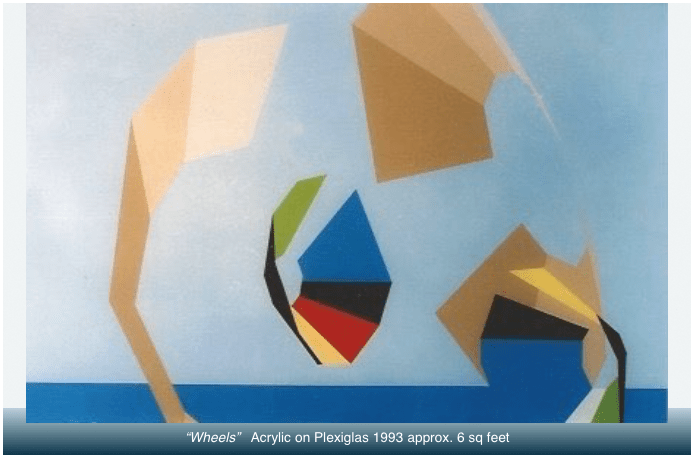
Wheels

Post 2g

During the weeks I worked on this hard-edged acrylic on plexi in 1993 the Stratford Concert Choir I sang with was very busy practising—for its annual December Concert—an exultant choral piece named “Wheels”.

A local composer, Geoffrey Thompson, had taken text from the prophet Ezekiel and set it to thunderous, rapturous music for organ and choir;  very Sci-Fi and dramatic;  epic space odyssey music of apocalypse.  Ezekiel had apparently witnessed the arrival of spaceships upon his desert landscape, and in a sense, and in his own time frame, had been “blown away” by the noise and spectacle, and the unworldly technological terror that so surpassed his own bronze age.

I couldn’t escape the overt influence of the wheels imagery, but for my purposes, I wanted only an ocean horizon and an infinitely deep sky that would be simultaneously real and abstract.  Unlike Ezekiel I was not courting any narrative of imminent danger or terror.  I was not intent on predicting apocalypse.  I wanted only visual contradictions in which the scale and placement of shapes are unknowable.  The beige / tan lenses, or digital camera shutters—just beginning to terminate the use of film—are thus purposefully closer than close and further than far while being at the same time reversible illusions (in the way an etching or drawing by Escher contains stairwells that visually flip inside / outside, upside / downside).

My reward for pursuing my own vision was that immense depth and purity of colour, space, and timeless quietude emerged despite the small physical scale of the painting.  In a year or two Mr. Thompson had died and my painting had already gone to sing its French Horn notes from the wall of the friend with whom I sang the First Bass melody lines of Wheels.

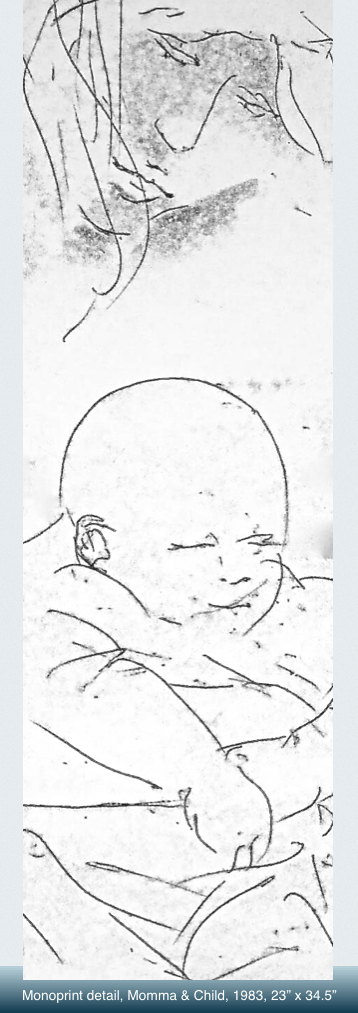
Momma & Child

Post 2e

A series of monoprints done in 1983 gave me the very challenging prospect of learning to draw blind and remain decisive, and in proportion, while drawing in reverse.  It taught me (1) surrender to the process, and (2) collaborate with the medium, and thus set me up wonderfully well for the acrylics on plexiglas I co-created with my materials in the late 80s.  

In the monoprint process a printing paper is placed face down in ink rolled onto a glass surface;  the artist draws upon the reverse side;  pencil pressure transfers ink onto the paper with the artist having no assurance of final result until the paper is pulled away and turned over.  

Extraordinary good luck stayed with me as the entire series of about three dozen prints were, on the overall, as bold and incisive as this one detail. 

One gallery, bullied by feminists and its own board of directors, reversed its contract to exhibit the series and informed me I would never exhibit with them again unless I found other subject matter;  one gallery accepted them but kept them in its print drawer until deciding to return them all to me;  The University of Waterloo did exhibit ten of them in 2005.  One viewer wrote in the comments column of the exhibit diary: “You gotta be kidding”.

Take Two

Post 2d

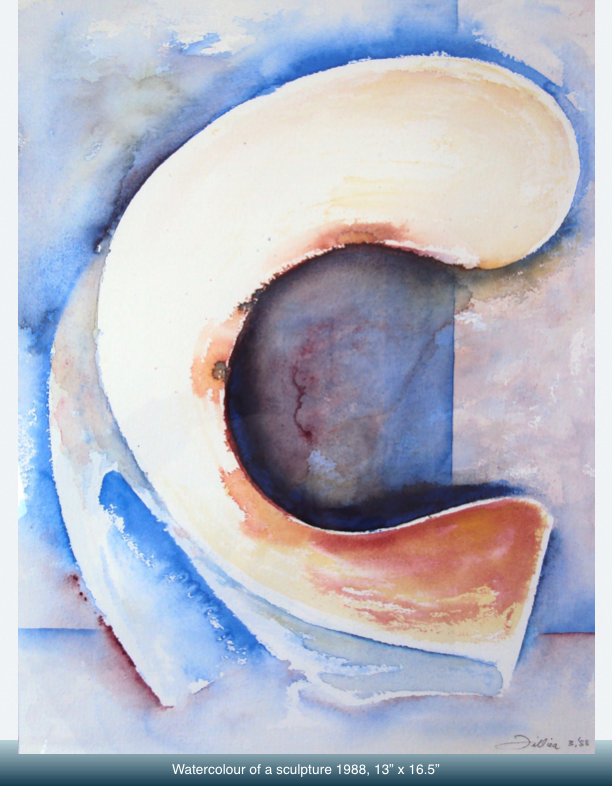
This sculptural object, being of rather thin plaster, survived a mere three years.  One day it tumbled from table to floor and I chose to not repair or remake it because it always reminded me of a penitent or perhaps even a grieving Madonna: Yes I had wanted gestural abstraction but not one to evoke religiosity. 

Fortunately a small watercolour made before the accident restored the original intent—a dancer or gymnastics athlete in an extravagant cirque-de-soleil choreography.  And whereas the original was white with few contrasting shadows, here, in a fresh start, was an opportunity that could be invested with dazzling blues and reds.

Three aesthetics emerged: a rather accurate rendering of the original form / shape with the dark, anti-matter negative shape becoming a powerful new force, plus,  the watercolour itself put on that array of dazzling riffs that the medium so exuberantly performs when allowed its own voice and minimal interference.

Some Faces Drawn 2

Post 1f

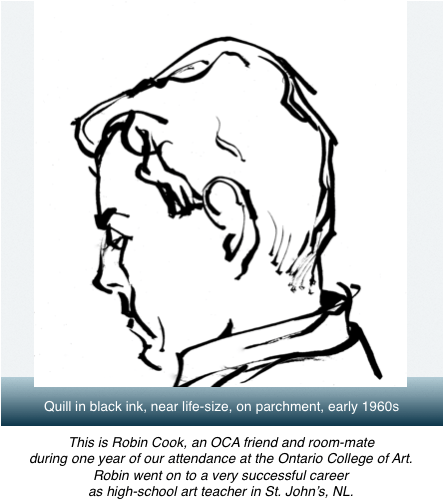
The example above is evidence that using just a quill in portraiture, even if it is for the first and only time ever, can yield astonishing results, for as spare as they are, the inscribed pitch-perfect lines still manage to evoke every nuance of Robin’s look at about 23.

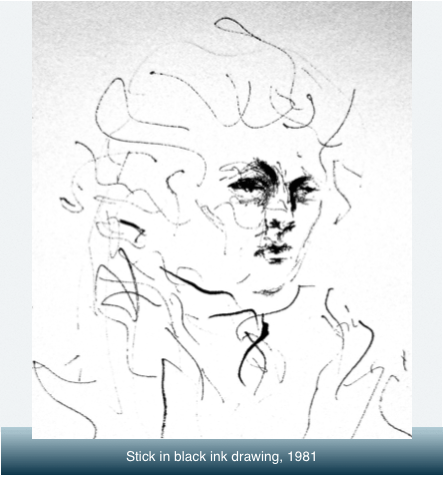
One of the most charming drawings I ever parented is the one immediately below, drawn with the end of a small stick dipped in ink.  This sketch can also be singled out as one that is jam-packed with rhythm, harmonics, and melodic phrases.  And the poetics of the unconventional approach.

Perhaps it’s even a “classic” Scott, begun as a find-a-drawing exercise: you start with a blank sheet and assemble marks one by one, allowing each succeeding mark to feed off its predecessor until they accumulate into one unified image.  This full drawing addresses the sitting figure to the knees and maintains the same touch throughout.  We each know a personality in the perpetual ruffle of brooding or walking on eggs.

Post 1g

Some Faces Drawn

Studies and sketches of faces with commentary. For a more comprehensive view of the overall variety of approaches but without commentary try the following YouTube video link:

Drawings of Faces by Filliere Parts A & B


Post 1k

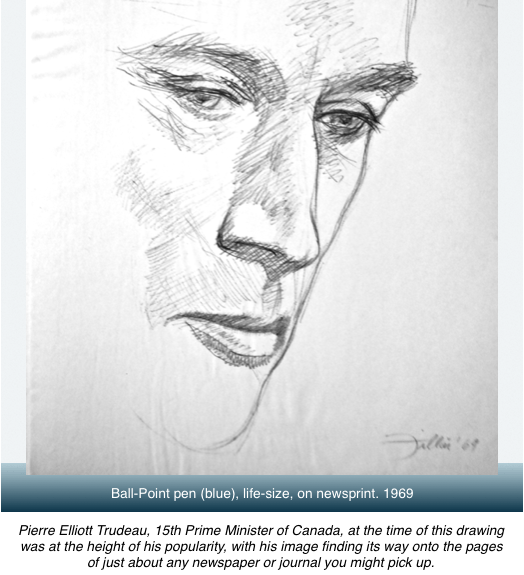
No precious pre-planning of shape, size, proportion here; no preliminary gridding for eye, nose, and mouth placement.  Quite simply, I saw another image of Trudeau in a newspaper, grabbed available paper and pen, and scorched the page with the image as I perceived it, somehow managing to incorporate other impressions gathered elsewhere of the character of Mr. Trudeau.  Done at warp speed I feel it misses nothing essential about the way we remember the personality of the man.


Post JD

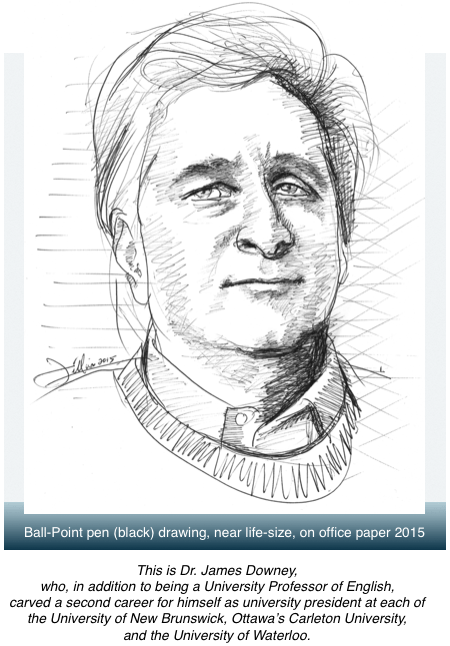
James and I have known each other since we were 16-year old freshmen at Memorial University in NL in 1956.  In the past decade he and I have worked together on three privately authored (his authorship), designed, stitched & assembled, limited edition book projects (my role—those latter aspects).  One of the three, Lord Beaverbrook and the Kennedys, was chosen by University of New Brunswick for a formal public edition published in 2012. It honoured most of my original design concepts for cover and inside but chose a black and white format rather than colour.  I keep it like a trophy on my favourite books shelf.

This year was the first time I’d attempted to draw him, and I’m so pleased and relieved to say that the portrayal came to the paper with the same readiness, sureness, and speed as with the Trudeau image, though 45 years separate them in production.

Peter Gzowski used to enjoy that remarkable social ease and generosity in Jim’s nature, and invited James to his CBC Morningside radio interview program on several occasions.