Spark

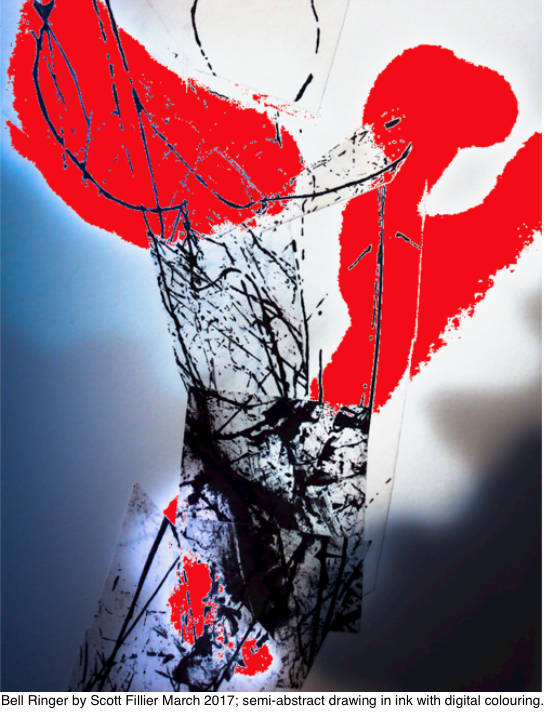
AbsDrawTitle5

As soon

as I decide to blog

but as yet without

a chosen flog

the word “spark”

unplanned, unsought,

and as yet unfiltered,

parks itself point blank,

behind/in front of

the dark third eye;

the outer eye premature, stressed,

worried as a hemp-rough bell-rope

fingered, palmed, dangled, waiting,

waiting taut to be pulled sore

at the front of the cue,

at the front for the cure:

where the lure of live art

queues up like a ritual

Guy Fawkes Five

or a banner spangled Four.

AbsDrawTitle4

Like any old flash

all steeple tense,

all tower taut,

all seriously trigger-happy,

the bell-ringer’s incendiary fingers

ring out, tell out,

draw,

paint out

the negative charge,

the positive hots,

the hot spots and the cold spots

of yesterday’s within.

Tooling the Temporary

via Daily Prompt: Temporary

Ft. Amherst 1

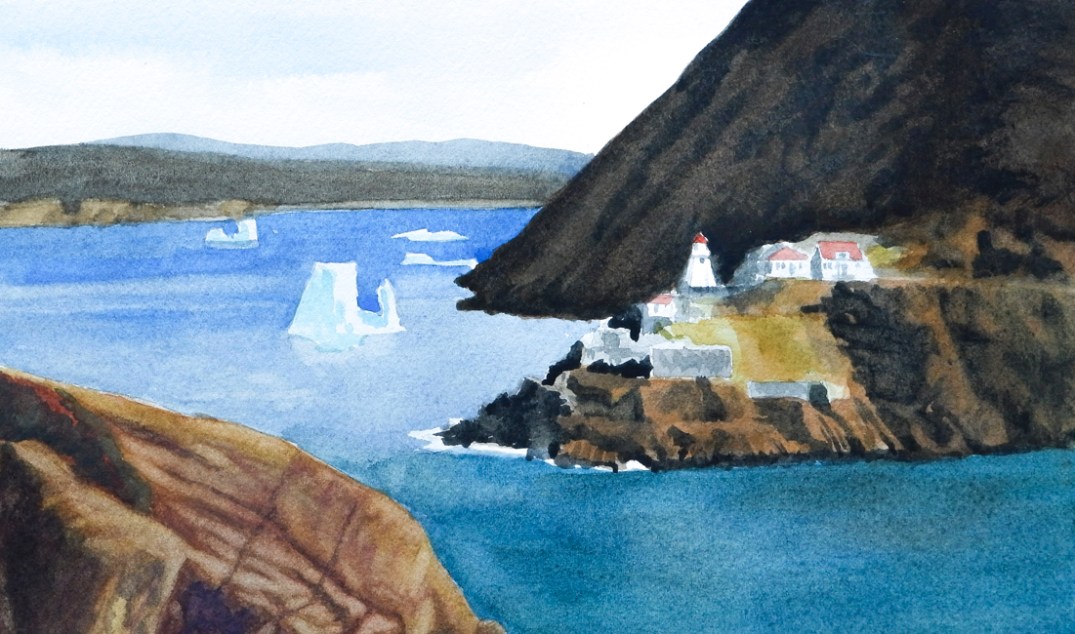
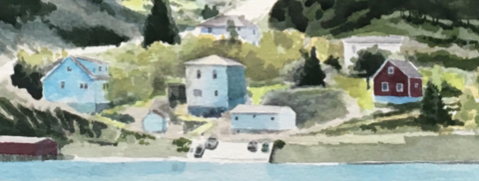
Transitory light of a setting sun emblazons the Fort Amherst south-side headland of St. John’s, NL in late April 2015. The viewpoint, from the Signal Hill side of The Narrows, is evanescent and spectacular where a climber, high, high, high amongst the rocks is breathless with vertigo not only from the steep climb up from The Battery, but from the stunning beauty of the distant view of lighthouse, houses, and support buildings in their dazzling display of white structures with red roofs, set against steep, stark shadows. Below them there is a large, steeply pitched area of withered grass with just a hint of seasonal change to green. Below that, several grey World War 2 concrete defence bunkers, with their crude early forms of architecture brut perched precariously, scrunched down, pretending to be equals of ancient, eternal crag, scarp, and cliff. At the final level down is the patient ocean with its longing to subdue the vain concrete forms.

A little offshore some pack ice and bergs imperceptibly drift into intertidal oblivion. The climber, clinging and resting amid some shrubbery in a rock crevice, steadies herself with one hand, and with the other raises her phone to capture the ephemeral scene. Breath held and then there is one barely audible fleeting click to record it, and some other clicks to send a copy on to me and others.

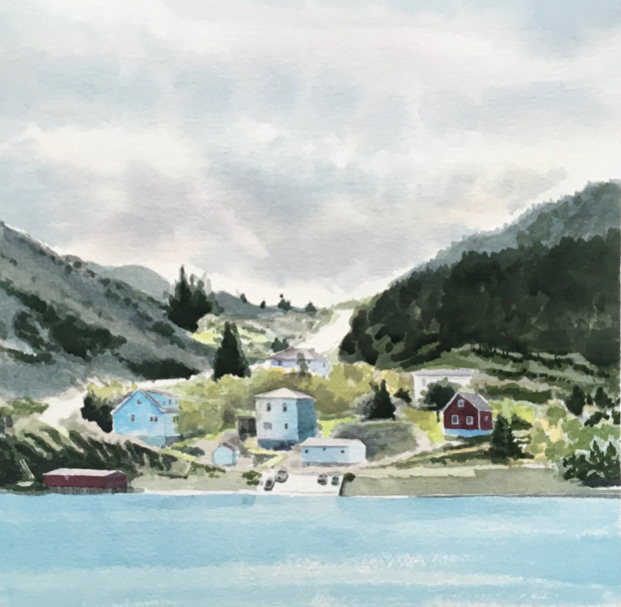
This week, two years later, I’ve used cousin Brenda’s photo to interpret the scene in what is considered to be the most useful medium to capture transient and fleeting effects: watercolour.  Perhaps I can tool the temporary into something that might endure, like the bunkers, for at least some generations beyond my immediate goal.

Ft. Amherst 2


Kalanchoe B&W

Kalanchoe2D

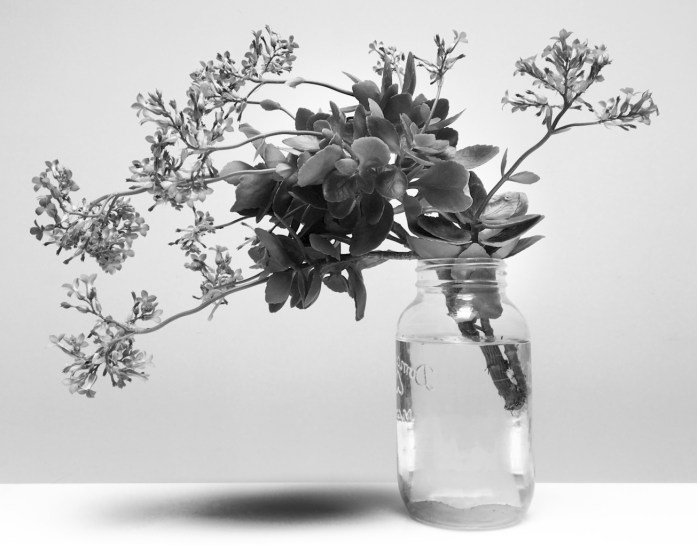
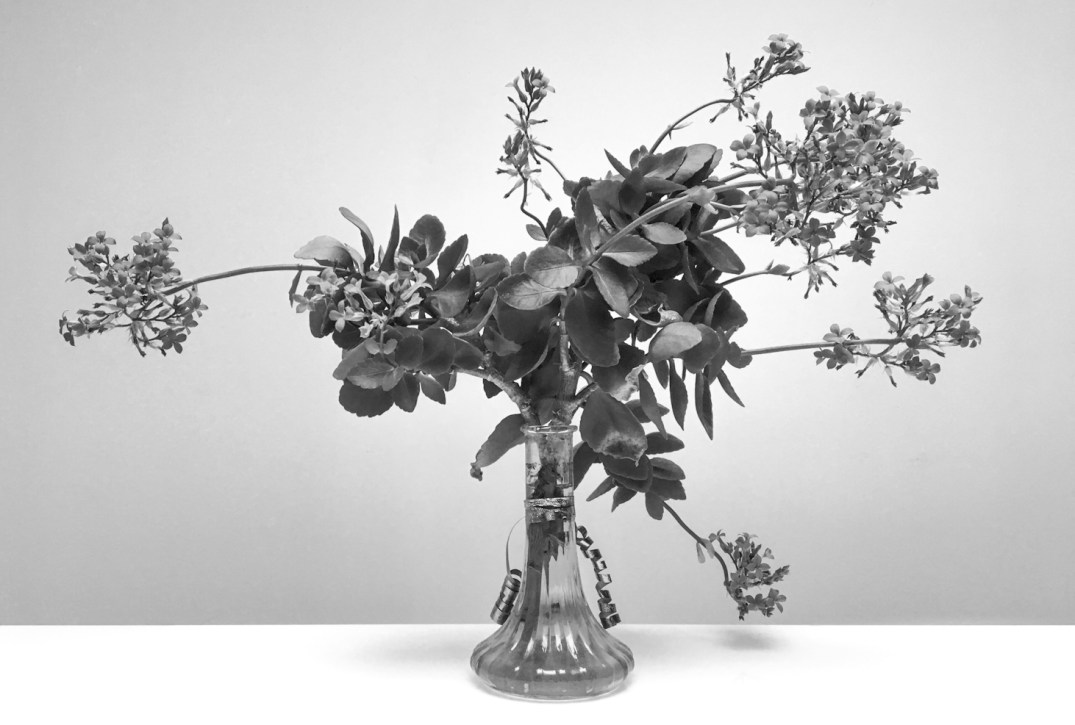
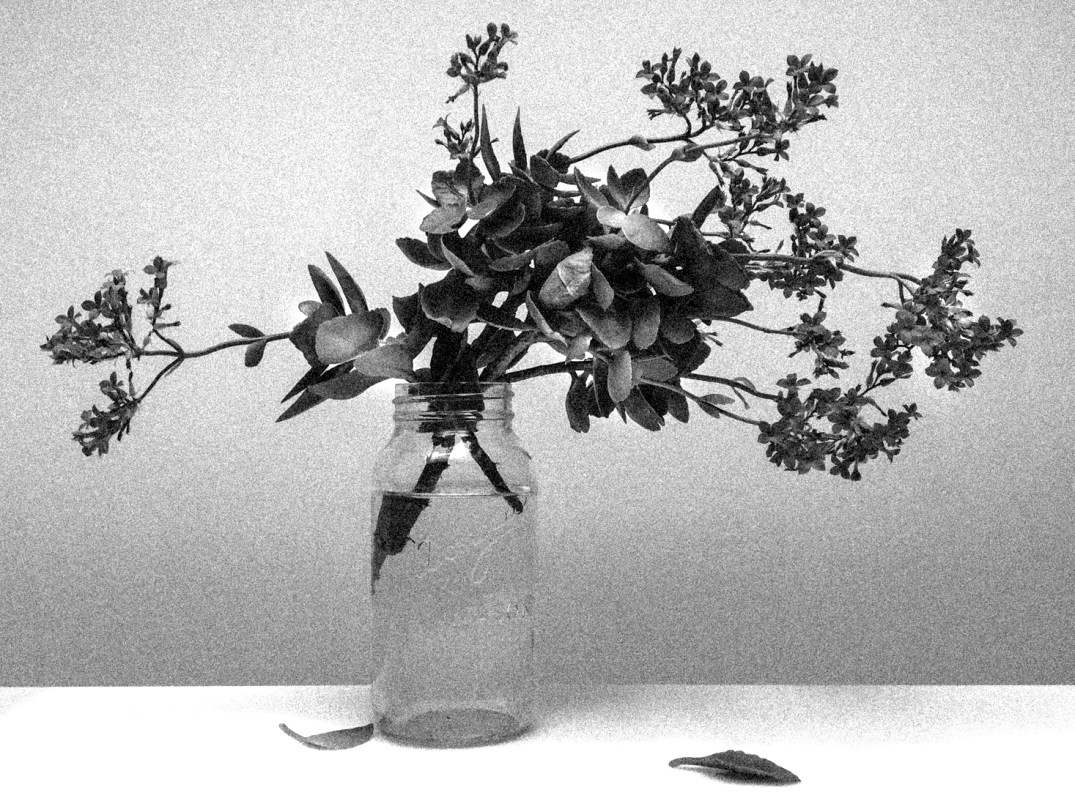
Yesterday I processed still further the photos from my Wednesday posting of a recently broken Kalanchoe but this time omitting its muted orange-red of bloom, and its brilliant glossy green of leaf.

KalanchoeB1

Astonishment: The result was anything but diminished. Shape, form, texture, and tone could more clearly have their turn to dance and pose under a quiet light.

KalanchoeB2

A pretty plant turns art object; something of the nonpareil, something pleasing, somewhat meditative/contemplative, and soothing for the searching eye.

Kalanchoe2C


Kalanchoe Poetics

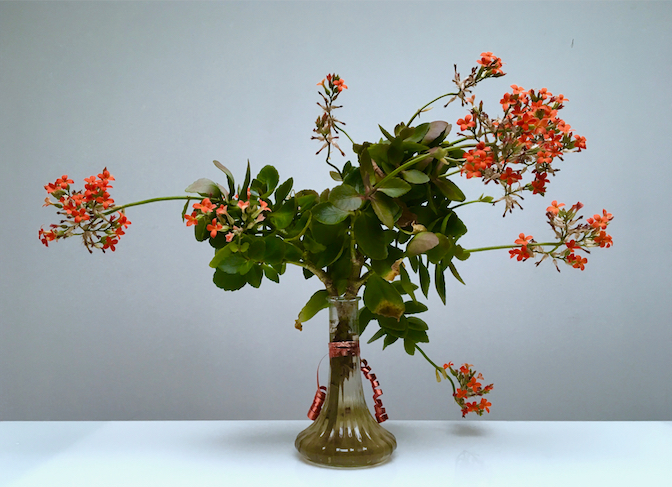
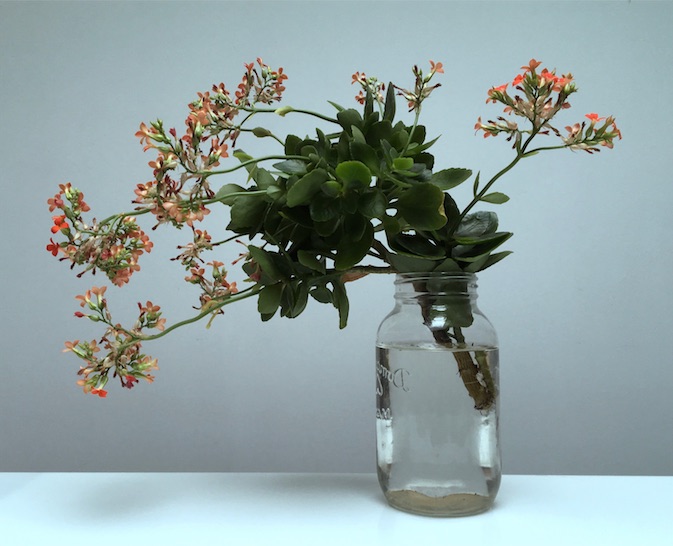
Two weeks ago, too heavy with bloom I presume, much of my Kalanchoe fell out of its container.

So heavy were the stems that they tore themselves off at the root simply from the mass of flowers, leaves and stem. Could be I overwatered and the succulent stems stored moisture until they were too heavy. Or: this may also simply be part of the plant’s reproductive strategy, and I am merely a different kind of bee.

Kalanchoe1

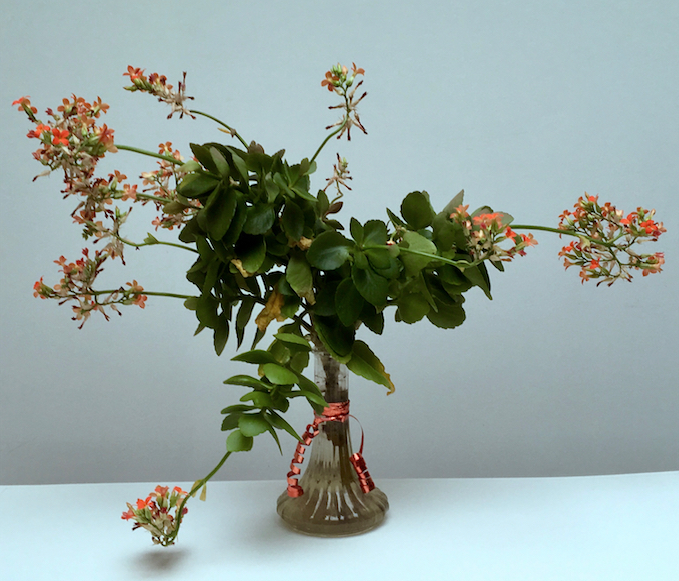
It had been in bloom for nearly three months, indoors of course, as it is a tropical plant, an exotic from places like Madagascar, and from eons of genetic memory still prefers to bloom during our winter.  The stems that fell out were so loaded with dead-gorgeous glossy green leaves and clusters of small, orange-red, 4-petalled flowers that I pulled out a glass vase and a glass preserve jar and put a couple stems, along with water, in each container, and put them back on window benches so I could spread the spectacle of its particular danse-chorale wider and deeper into this slow Spring.

Kalanchoe3

Already each stem has grown roots ready to become new plantings, and enough of the original plant remained in the container for a healthy regrowth as soon as it is warm enough to put it outdoors.

Kalanchoe2

In the meantime today was the day to make a visual record under natural light and without embellishment of any kind just to celebrate an ordinary Kalanchoe’s extraordinary interpretation / meditation / grasp and poetic take on the grace of being.

J. D’s GD Punt

via Daily Prompt: Cranky

In the marine environment into which I was born and raised the word cranky primarily described and implicated certain boats.

Implicated? Yes indeed: It was ethically, even morally reprehensible to own such a conveyance. And even more so to lend it out without fair warning.

“Don’t ever borrow Jack Denney’s punt”, neighbours would caution with lowered voices, “not fit to talk about.”

Nothing precisely had been said about said boat, and nothing else needed saying; John Denney owned and was always eager to lend out his beloved self-built cranky boat, and one could see from his self-built bungalow that if ever it went to sea it would be as cranky as his punt.

The absence of roads, and I warrant you Gleeville was a long way from being Venice or Amsterdam, this absence of roads compelled dories, punts, and putt-putt motorboats to be, in the early 1940s, aside from walking, the major conveyance from one outport to another, or locally from up-town Tickles Bridge to down-town Barred Island; or, for Social Use, merely across-town for High Tea with Aunt Floss and Uncle Si in Logan’s Cove. Aunt Floss had long ago publicly condemned both her son’s boat and his house.

Thus cranky had almost no connection whatever with the way I, or anyone out-of-sorts might be feeling, but everything to do with the fear and anxiety engendered, if Mother, holding me in her arms, passed me into father’s waiting arms, with him already standing, or even already seated in Uncle J. D’s GD cranky boat. The unstable, unpredictable wobble that could follow was hair-raising, (even for father with his thinning hair), ((even for a somewhat bald three-year-old)), and became all the more dangerous if I added to it with flailing limbs, and terror-filled squalls.

And so it was that I quietly absorbed the word cranky right along with the imprinted smell of salt in the air, and the sound of high-tide waters slapping gently at the posts that supported Grandmother Denney’s house on its granite boulders in our sheltered little cove. Along with that absorption came a life-long aversion to becoming, or wallowing in any expression of willfulness or instability of emotions. Crankiness and stability have always seemed to me, like boats, to be conveyance options of choice.


Ripples of Ending / Beginning

Beautiful BlindA

Several days ago, in an upstairs storage area, having recently returned to making watercolours after a five, seven, perhaps even a 10-year hiatus, I pulled my old stretching board for wc paper from its position behind some old art materials and supplies.

“Bonus,” the board beamed with a near-auditory inflection, as it held an already stretched piece of first-class paper still taped into position. The ‘Arches’ stamp in the lower left corner identified it as such. And the fact that I was seeing that imprint in reverse ought to have tipped me off to the exact nature of my later discovery.

I’d already chosen my subject so without thinking twice I installed this big one-inch-thick slab of warp-resistant plywood with its stretched paper onto my easel, and at once set about to pencil in some marks that would help me lock down the landscape I hoped to render in watercolour.

Beautiful BlindB

For our purposes in this story we can speed-edit forward to about three days later and a successfully executed painting. New to the watercolour game again I chose to approach the image in about four well paced out stages rather than in the one all-or-nothing emotional gamble one can otherwise take with watercolours. So now it was time to untape the image, separate the finished work from the board, and view it without the messy tape at its edges. In that process the item fell to the floor and in so doing revealed its reverse side.

Beautiful BlindC

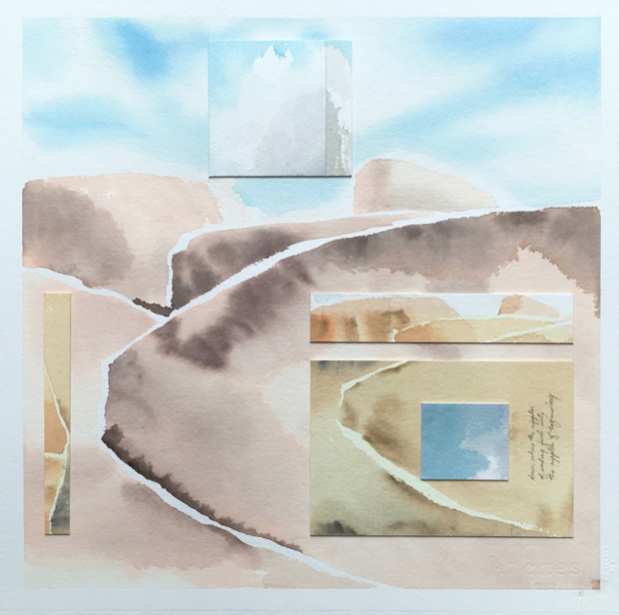
At a first glance, neither ‘pro’ nor ‘con’, and in some consternation at the quandary posed for display, the two sides seemed to have nothing in common. The item on the original side is radically different in technique which includes collaged segments from a separate watercolour (I do have two other previous wc works which also explore slice/rip/chop and paste) though this one adds a phrase from one of my poems.

And yet, by titling, these particular two are close Canadian kin: “Oceanside, Collins’ Cove, Burin, NL, 2017”. And “Oceanside, Peggys’ Cove Light, Peggy’s Cove, NS, circa 2007-10”.

Anyone who knows the Peggy’s Cove rocks at the light there will find an instant connection and cognition.

By extraordinary coincidence the poetry quote aptly says, “…down where the ripples of ending furl into ripples of beginning…”

I’ve decided I like both images enough to build a display frame that will exhibit both sides simultaneously.

I will also continue to sometimes include collaged compositions in some of my future watercolours. It enables such different compositions!


Time-lapse Drawing as Art Form

ariel

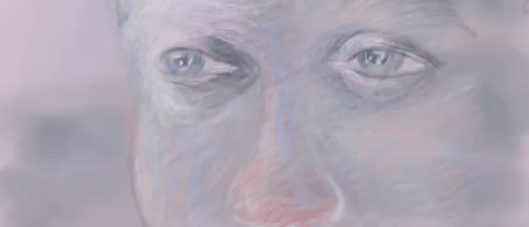
A favoured drawing technique noted in some of my earlier postings has been that of “finding a face” or “finding a figure” upon a blank drawing surface.

To refresh that concept:  without any references or preconceptions a drawing is begun by putting a random mark, or marks, upon the paper, and then my creative process engages with the marks and determines which probabilities, which kinds of lines/tones/colours, should logically follow as best response, for essentially it is a call and response technique of drawing.

A delightful bonus of recently using my iPad as drawing tool has been, that after finishing such a search-and-find image, the whole undertaking can be played back in the precise sequence and order in which it occurred, so the entire thought process is captured and reveals itself, stroke by stroke, as if in some sports replay from beginning to end. It is as fraught with challenge as a pool-side dive from a ten-metre platform. Even though it’s a product of my own hand and mind, even though it’s a speeded up version rather than a slow-motion replay, I find it instructive and entertaining to watch, and search, for clues about how to improve attack and technique. It is a fascinating study in which the process of “thinking without thinking” is integrated into deliberate, cognitive choices.

I’m attaching here an unedited time-lapse item, by which I mean no sequence of marks has been eliminated in any editing process, everything hangs out in the wash as is, including my realization well into this drawing, that the eye on the right side of the drawing needs to be, and does get redrawn a little further to the right.

Time-lapse, by eliminating all of my pauses, compresses about two hours of actual drawing time into 44 seconds. That may seem far too long a time for the resulting tentative image but it includes and explains the entire mental journey between first mark and last used for an acceptable, even artistic result to arise out of such a hazardous, gambled, evolutionary approach. And likely, one could indeed argue the far fetched comparison, it is not altogether so different from the four billion year life process of evolution itself, where genetic mutation/variation engage with logical physical properties of the environment, with form and function, for example, as final arbiters, and, if favourable, a trait will survive or get repressed. So too here sporadic, intuitive marks on-the-run are evaluated, accepted, abandoned, or are casually overdrawn, or redirected.

Among decisions made at the beginning:  if I want to use white as an active colour, and I do, I will need to establish some all-over background tones and colours other than white upon which to draw, hence the first few seconds of selecting and rejecting backdrop options. My unconscious immediately prepares me to begin drawing a subject suitable to the given time of day—dusk.  Another early choice is to use transparent colours because that is the closest way to allow the illusion of digital colours mixing one upon, or up against the other.  By ten seconds I’ve accepted the notion that it’s a face only that will evolve, one that already suggests an evanescent Ariel or Puck, a playful character from Shakespeare, light as air itself, with that sort of transparent face appropriate to the onset of night, just as Ariel has a human aspect but also belongs to some other order of being.  Very early on I give him the vulnerability of a red nose and decide to keep it for an artistic reason: besides being a symbol of his human enigma it warms up surrounding greys, blues and magentas.

At about 15 seconds in I see that this figure can fit into a sub-category within my drawings as “Whistling Figure”, so early on I have a ready title and goal. The remainder of my 44 seconds is spent developing the face while aiming for consistency of proportions, lighting, and mood, and adhering to a plan of minimal input for maximum outcome. Perhaps the most important move though is to stop before the drawing solidifies and edges too far into photo-realist territory: the psychology, the poetry, of an Ariel, or of a whistling figure, play into our imaginations best if shape and form are suggested rather than fully resolved.

Nothing Bespoke Consequences

flatislandphoto

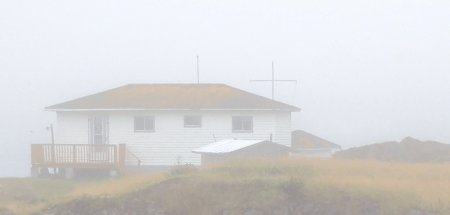
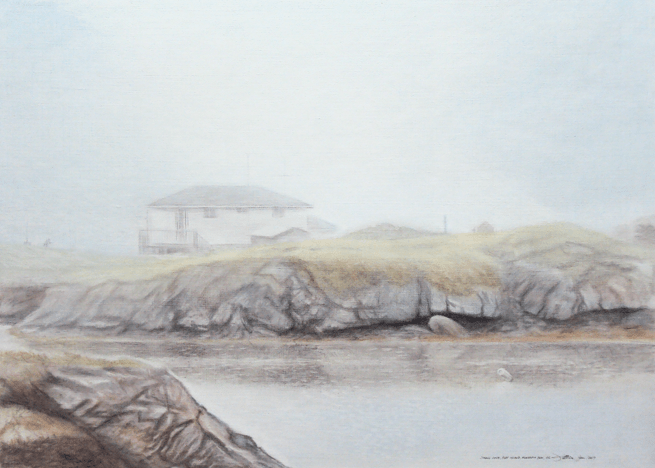
When I set out to create from photos the drawing below, in pencil, with a thin dusting of pastel, the tranquility of a summer cottage under a radiant Placentia Bay, NL fog, seemed to be the essential focus of the exercise. Nothing overtly bespoke of earth moving consequences.

Here is that little point of land almost in its entirety, left to right, base to tip. This is the merest of peninsulas, but one with two secluded harbours either side of it within a larger enclosed harbour. It is a short and narrow strip of land consisting of small undulating land forms, filled, according to season, with excessive dandelions, irises, buttercups, wild reeds and grasses, heather and lichens; and its low bushes, buildings, and out-buildings, are blissful and bucolic: surely I must admit that it is all too appealing, worthy of a sweet souvenir photo, yes, but not basis for an art piece. Where is the stress? The anxiety and awkwardness are missing. And missing also the contemporary challenge to beauty—an inclusive quantity or measure of ugliness!
flatislanddrawing2017

In fact so benign did it all seem during the first hour or two of drawing, (the piece is 21” x 29” so there are several days of drawing at stake), that in no time at all I thought I would have to quit from such a deficit of the engine that usually drives articles, essays, poems, musical compositions, plays, paintings, drawings: dramatic tensions / divisive oppositions / and in abstractions, the tonal and colour confrontations, all always in such need of aesthetic, artistic reconciliation.

And so, soon, a different truth, one of those divisive oppositions, asserted itself. The more I drew the more it became manifestly clear that this is not all about some current, summer driven, local, personal idyll of democratic freedoms and anarchic abandon of someone on Flat Island (aka Port Elizabeth), Placentia Bay, NL—an island on which permanent residents no longer live—but an oceanside residence that should only provoke a symphonic pastoral response if it is also a suitably brooding and reflective one.

I surely did, at first glance, swallow the illusion of Eden hook, line, and sinker. For some hours I couldn’t see past the waist-high grasses, the sly seduction of smooth waters, and the wispy, fog-filled ocean sky, whispering of exotic island locales like Bermuda, the Bahamas, Jamaica, and Cuba, all with due south ports of call from this once busy cod-fishing town. And then the implacable, the irreconcilible adversarial force, the bigger picture presented itself: the subject should be, could only be a definitive conclusive pencil portrait—water versus rock, how more plain and simple, and with water ultimately declared winner.

Goals: confront and acknowledge, and upgrade with appropriate and suitable weight of line and tone all that beaten-and-battered, broken-and-foundering rock; clarify the depth of that tidal low-water undercut which runs the entire length of the rock ledge; needed also, a reveal of that huge section of broken, segmented rocks many feet deep reaching back toward the line of buildings as the rock frontage is prepared by the ocean for launch in the not too distant future as a new local reef.

A mysterious and particularly purposeful universe? Not in my backyard. Here “nature” accomplishes without intent, unconsciously, and by simple mechanism: twice daily, more or less silently, tides rise and fall, press underneath the rock, suck outward with equal or even stronger force, pulling, and carrying out and away in its undertow the rock often already ground to rubble. In winter water as ice and frost assist. And all is accomplished unannounced, achieved so economically, so brilliantly without an approved business plan, and with such luxuriating timeless ease.
When Words Fail

drawnquartoed1

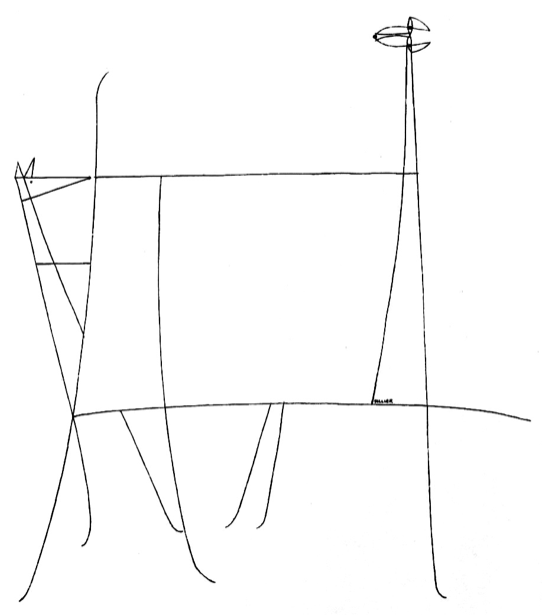
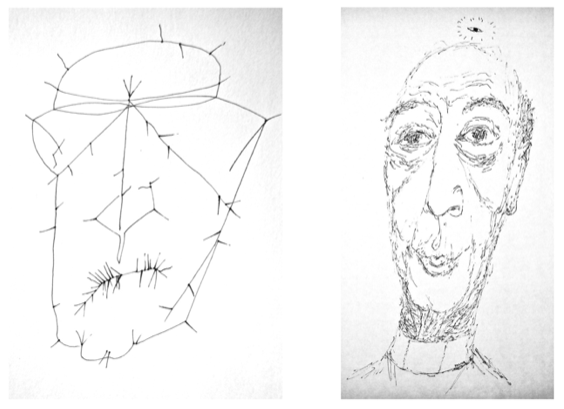
How many words to sum up the visual content of this image, let alone to try and express the ferocious economy of its wit and humour? Or of the characters instantly conjured in the following pair of faces.

drawnquartoed2

Seventy such images are available in the five minute YouTube video of mine at the following link. Treat yourself to a viewing: