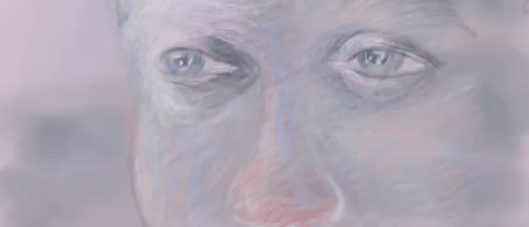
A favoured drawing technique noted in some of my earlier postings has been that of “finding a face” or “finding a figure” upon a blank drawing surface.
To refresh that concept: without any references or preconceptions a drawing is begun by putting a random mark, or marks, upon the paper, and then my creative process engages with the marks and determines which probabilities, which kinds of lines/tones/colours, should logically follow as best response, for essentially it is a call and response technique of drawing.
A delightful bonus of recently using my iPad as drawing tool has been, that after finishing such a search-and-find image, the whole undertaking can be played back in the precise sequence and order in which it occurred, so the entire thought process is captured and reveals itself, stroke by stroke, as if in some sports replay from beginning to end. It is as fraught with challenge as a pool-side dive from a ten-metre platform. Even though it’s a product of my own hand and mind, even though it’s a speeded up version rather than a slow-motion replay, I find it instructive and entertaining to watch, and search, for clues about how to improve attack and technique. It is a fascinating study in which the process of “thinking without thinking” is integrated into deliberate, cognitive choices.
I’m attaching here an unedited time-lapse item, by which I mean no sequence of marks has been eliminated in any editing process, everything hangs out in the wash as is, including my realization well into this drawing, that the eye on the right side of the drawing needs to be, and does get redrawn a little further to the right.
Time-lapse, by eliminating all of my pauses, compresses about two hours of actual drawing time into 44 seconds. That may seem far too long a time for the resulting tentative image but it includes and explains the entire mental journey between first mark and last used for an acceptable, even artistic result to arise out of such a hazardous, gambled, evolutionary approach. And likely, one could indeed argue the far fetched comparison, it is not altogether so different from the four billion year life process of evolution itself, where genetic mutation/variation engage with logical physical properties of the environment, with form and function, for example, as final arbiters, and, if favourable, a trait will survive or get repressed. So too here sporadic, intuitive marks on-the-run are evaluated, accepted, abandoned, or are casually overdrawn, or redirected.
Among decisions made at the beginning: if I want to use white as an active colour, and I do, I will need to establish some all-over background tones and colours other than white upon which to draw, hence the first few seconds of selecting and rejecting backdrop options. My unconscious immediately prepares me to begin drawing a subject suitable to the given time of day—dusk. Another early choice is to use transparent colours because that is the closest way to allow the illusion of digital colours mixing one upon, or up against the other. By ten seconds I’ve accepted the notion that it’s a face only that will evolve, one that already suggests an evanescent Ariel or Puck, a playful character from Shakespeare, light as air itself, with that sort of transparent face appropriate to the onset of night, just as Ariel has a human aspect but also belongs to some other order of being. Very early on I give him the vulnerability of a red nose and decide to keep it for an artistic reason: besides being a symbol of his human enigma it warms up surrounding greys, blues and magentas.
At about 15 seconds in I see that this figure can fit into a sub-category within my drawings as “Whistling Figure”, so early on I have a ready title and goal. The remainder of my 44 seconds is spent developing the face while aiming for consistency of proportions, lighting, and mood, and adhering to a plan of minimal input for maximum outcome. Perhaps the most important move though is to stop before the drawing solidifies and edges too far into photo-realist territory: the psychology, the poetry, of an Ariel, or of a whistling figure, play into our imaginations best if shape and form are suggested rather than fully resolved.
 fillière